Security Lighting for Commercial Properties in 2026
Discover how security lighting protects commercial properties, reduces risk, and improves safety. Expert insights for property managers in 2026.
Have you ever walked past a dark commercial building at night and felt uneasy? That instinctive reaction tells you something important: proper illumination matters. For property managers, facility directors, and building owners, security lighting represents one of the most fundamental layers of protection for commercial properties. It's not just about flipping on a few floodlights. It's about creating a comprehensive strategy that deters criminal activity, enhances safety for employees and visitors, and reduces liability exposure.
Why Security Lighting Matters More Than Ever
The landscape of commercial property protection has evolved significantly. Modern security lighting does far more than illuminate dark corners. It integrates with surveillance systems, adapts to environmental conditions, and provides measurable improvements in safety outcomes.
Research shows that well-designed lighting systems can reduce crime rates in commercial areas by creating what security professionals call "natural surveillance." When potential intruders know they can be easily seen and identified, they typically move on to softer targets. The Department of Homeland Security emphasizes that effective security lighting prevents intrusions while enhancing safety for both responders and the public.
But here's the thing: not all lighting delivers these benefits equally. You need to understand the principles behind effective design.
Key Components of Effective Security Lighting
What makes a security lighting system truly effective? Let's break down the essential elements that separate professional installations from amateur attempts.
Strategic Placement and Coverage
Security lighting works best when it follows a layered approach:
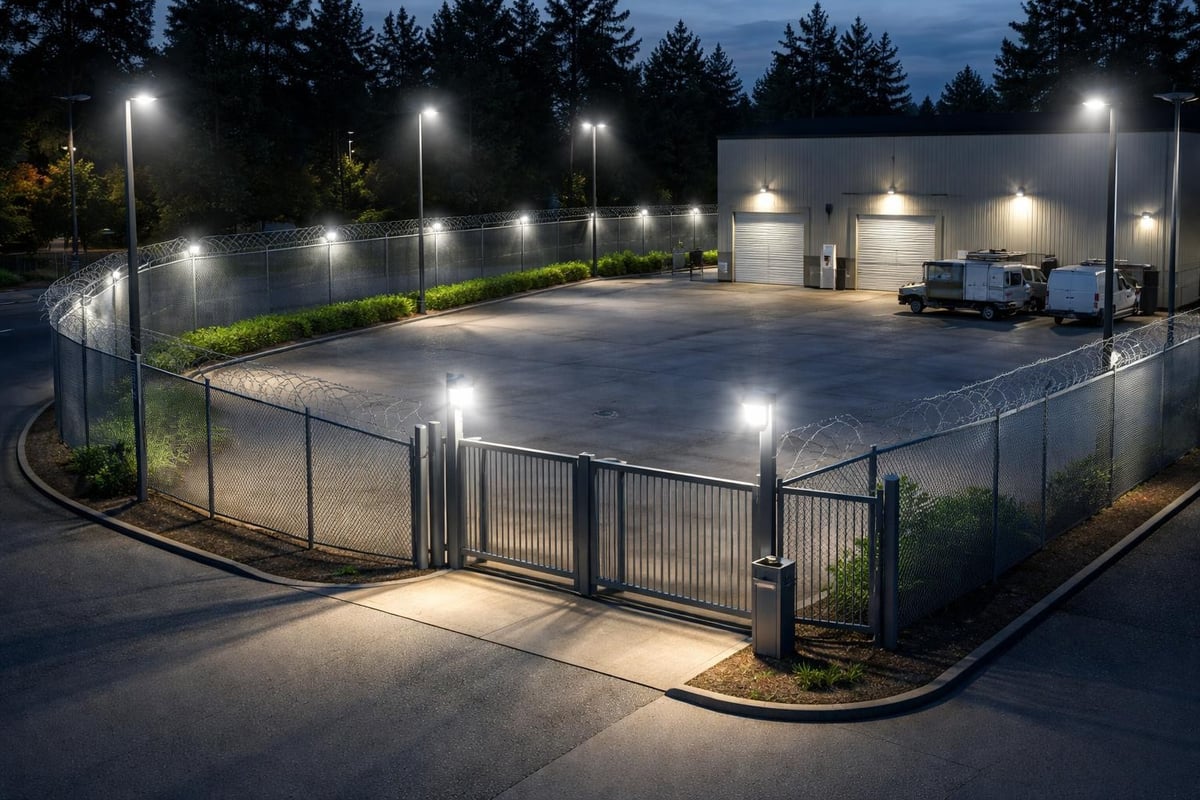
Perimeter lighting that illuminates property boundaries and fencing
Access point lighting for doors, gates, loading docks, and parking areas
Building-mounted fixtures that eliminate shadows near walls and entrances
Pathway illumination ensuring safe movement throughout the property
The goal isn't to light everything like a sports stadium. Instead, you're creating zones of coverage that overlap strategically. Think about how light interacts with your building's architecture and landscaping. Are there recessed doorways that create hiding spots? Do trees cast shadows that could conceal someone?
Technology and Control Systems
Modern security lighting leverages smart technology to maximize effectiveness while minimizing energy costs. Motion sensors trigger lights only when activity is detected in specific zones. Photocells automatically adjust for ambient light conditions. Timer systems ensure consistent operation without manual intervention.
Adaptive outdoor lighting systems can reduce energy consumption by up to 60% while maintaining security coverage. These systems dim lights during low-activity periods and brighten them instantly when motion is detected.
Technology Type
Primary Benefit
Best Application
Motion Sensors
Energy savings + deterrence
Perimeters, secondary entrances
Photocells
Automatic day/night operation
All exterior fixtures
Smart Controls
Remote management + scheduling
Large campuses, multiple buildings
LED Fixtures
Long lifespan + efficiency
Replacement projects, new construction
For commercial properties undergoing upgrades or renovations, integrating security lighting into broader electrical renovations and upgrades ensures compatibility with modern control systems and energy codes.
Design Standards and Best Practices
You might be wondering: how bright should security lighting actually be? The answer depends on your specific application and local requirements.
The Illuminating Engineering Society has developed detailed guidelines for security lighting in critical infrastructure. According to IES G-1-22 standards, different areas require different illumination levels based on their security sensitivity.
Illumination Level Guidelines
High-security zones (loading docks, equipment yards, vulnerable building areas):
Minimum 1.0 footcandles average
Maximum 4:1 uniformity ratio (avoiding harsh contrast between bright and dark areas)
Medium-security zones (general parking, walkways, building perimeters):
Minimum 0.5 footcandles average
Maximum 6:1 uniformity ratio
Low-security zones (landscape areas, remote perimeters):
Minimum 0.2 footcandles average
Maximum 10:1 uniformity ratio
These numbers might seem technical, but they translate to real-world safety outcomes. Proper uniformity prevents the harsh shadows that create hiding spots.
Balancing Security with Community Responsibility
Here's something that often gets overlooked: your security lighting affects more than just your property. Poorly designed systems create light pollution, disturb neighbors, and may even violate local ordinances.
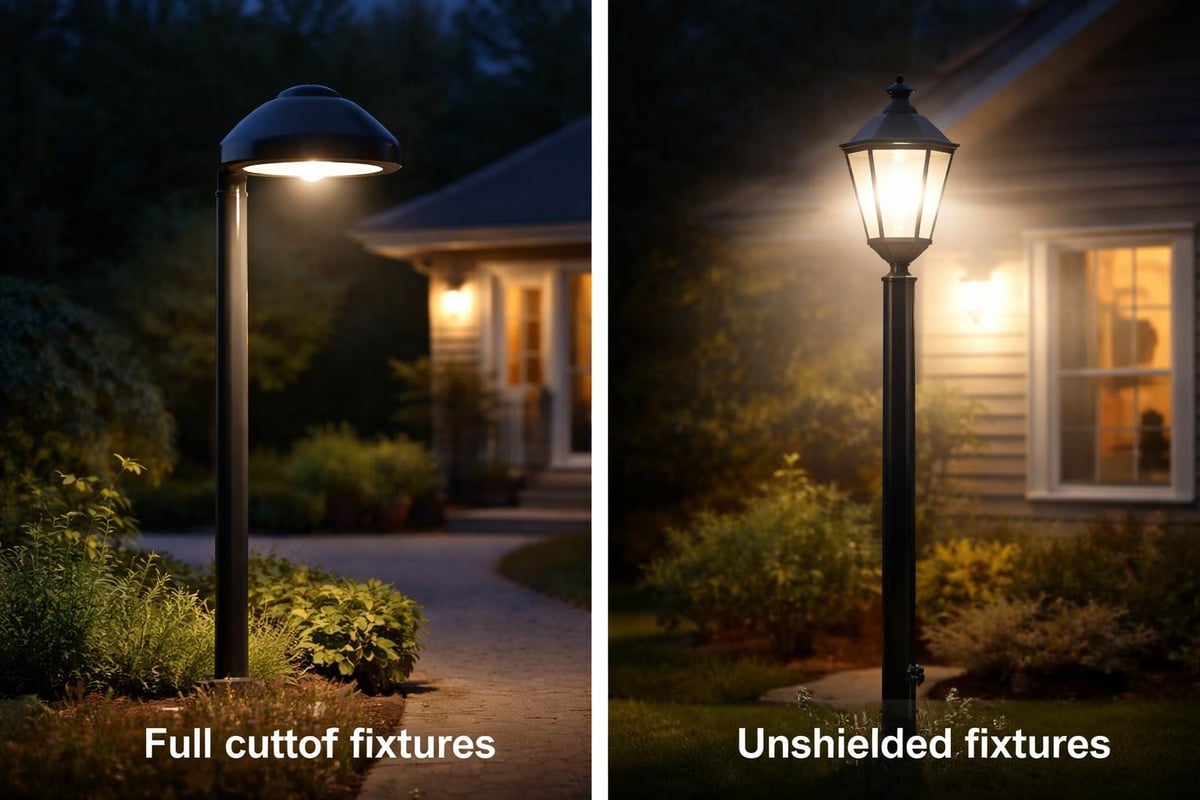
The National Park Service’s lighting standards emphasize reducing light pollution while maintaining security. This balance matters for commercial properties too. Full-cutoff fixtures direct light downward where you need it rather than spilling into the sky or neighboring properties.
Studies examining urban nighttime lighting and perceived safety demonstrate that quality matters more than quantity. Excessive glare can actually reduce visibility and create discomfort, working against your security goals.
CPTED Principles in Action
Crime Prevention Through Environmental Design (CPTED) provides a framework for using lighting strategically. Research on CPTED and community street lighting shows how proper illumination enhances natural surveillance without creating fortress-like environments.
The principles are straightforward:
Provide clear sight lines so security personnel and passersby can observe activity
Eliminate entrapment zones where someone could be cornered in poorly lit areas
Define property boundaries with consistent perimeter lighting
Distinguish public from private spaces through lighting transitions
Maintenance and Long-Term Performance
Installing a great security lighting system is just the beginning. Without proper maintenance, even the best design deteriorates over time.
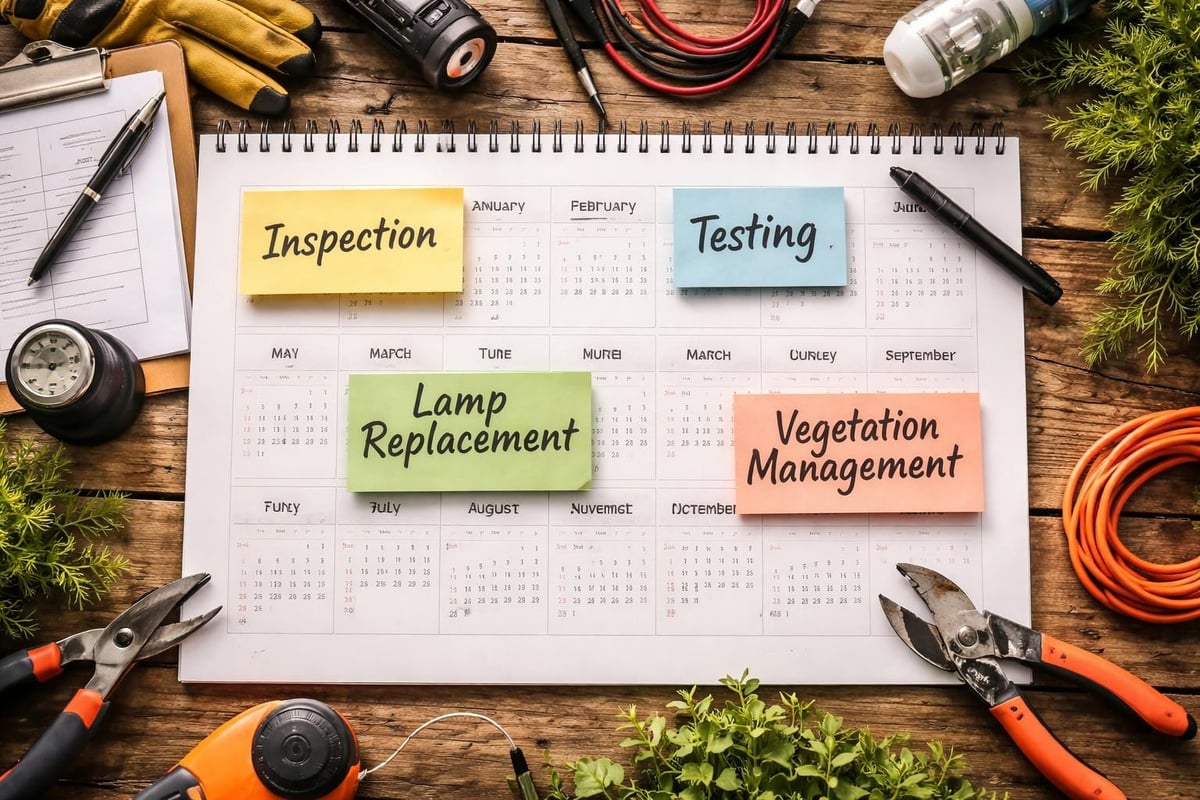
Lamp burnout, fixture damage, and vegetation growth can all compromise your system's effectiveness. That's why developing a maintenance schedule matters just as much as the initial installation.
Essential Maintenance Tasks
Monthly visual inspections of all fixtures
Quarterly lamp replacement for critical security areas
Semi-annual vegetation trimming around light sources
Annual system performance testing and adjustment
Immediate repair of damaged or vandalized fixtures
The Emergency and Security Lighting Handbook provides detailed guidance on maintaining system reliability over time, including backup power considerations for critical applications.
Making Smart Investment Decisions
How do you know if your current security lighting is adequate? Start with a professional assessment that evaluates:
Coverage gaps and shadow zones
Illumination levels and uniformity
Fixture condition and technology age
Energy consumption and operating costs
Integration with existing security systems
Many property managers discover that upgrading to LED fixtures with smart controls pays for itself within 3-5 years through energy savings alone. When you factor in reduced maintenance costs and improved security outcomes, the investment becomes even more compelling.
Practical security lighting guidelines recommend avoiding over-lighting, which wastes energy and creates harsh glare, while ensuring adequate illumination where it actually matters.
Investment Area
Typical ROI Period
Key Benefit
LED Conversion
2-4 years
Energy + maintenance savings
Motion Sensors
1-3 years
Reduced operating hours
Smart Controls
3-5 years
Optimization + remote management
Design Consultation
Immediate
Avoid costly mistakes
Protecting your commercial property requires thoughtful planning and professional execution. When security lighting is designed properly, it creates safer environments, reduces risk exposure, and operates efficiently year after year. Whether you're planning new construction, upgrading existing systems, or simply evaluating your current setup, the right partner makes all the difference. GM Roofing & Electrical Services brings more than 25 years of commercial electrical experience to every project, approaching your security lighting needs with the same integrity and craftsmanship that has built our reputation across Dallas and Fort Worth.
Learn why preventative electrical maintenance is critical for commercial buildings. Discover best practices, inspection schedules, and cost-saving benefits.