Emergency Roof Repair? There’s a better way.
I spent the last year analyzing commercial roof failures across dozens of properties. The numbers told a story that most property managers don’t see until it’s too late.
A 4:1 ROI on preventive maintenance sounds good in theory. But when I started tracking actual cash flows, the real gap between planned maintenance and emergency repairs shocked me.
Here’s what the numbers actually look like.
The Real Cost Structure Nobody Shows You
I’ll start with a property I tracked closely. A 100,000-square-foot warehouse with a roof installed at $8.00 per square foot. Total investment: $800,000 with a 20-year warranty.
The planned maintenance approach costs approximately 1% of the original roof cost annually. That’s $8,000 per year.
The reactive approach looked cheaper at first. No annual budget. No scheduled inspections. Just fix problems when they appear.
Then the failures started.
Without maintenance, the roof’s effective lifespan dropped to 15 years instead of 20. During the final three years, major repairs cost 3% of the original roof value annually. That’s $24,000 per year.
The math breaks down like this:
Planned maintenance over 20 years: $8,000 × 20 = $160,000
Reactive repairs over 15 years: Minimal costs for years 1-12, then $24,000 × 3 = $72,000 in emergency repairs during years 13-15, plus early replacement at year 15 instead of year 20.
That early replacement alone represents a $400,000 capital expenditure five years ahead of schedule.
The Emergency Repair Premium
Emergency roof repairs carry a premium most people don’t anticipate.
I found that emergency services cost 25-50% more than routine fixes. The urgency fee alone adds $300 to $1,500 on top of standard repair costs.
After-hours service, expedited materials, and emergency crew deployment all compound the base cost.
For a 50,000-square-foot facility, planned maintenance runs $10,000 to $20,000 annually. Predictable. Budgetable. Manageable.
Emergency repairs on the same facility hit unpredictably. One major failure can consume $40,000 to $60,000 in a single event.
The timing matters too. Emergency repairs happen when the roof fails, not when your cash flow can handle it.
The Hidden Costs That Destroy Your Budget
The roof repair invoice represents just the beginning of your actual costs.
Tenant disruption creates immediate revenue impact. I tracked one property where emergency roof repairs forced a two-month partial closure. The tenant’s business interruption claim exceeded the roof repair cost by 3x.
When roof leaks become visible inside buildings, damage has typically been developing for months. By then, you’re facing:
- Professional water cleanup and restoration services
- Interior drywall and paint repairs: $3,000+
- Structural repairs: $4,000+
- Potential mold remediation: $1,500 to $15,000
One warehouse I analyzed faced $100,000 in roof replacement costs after neglecting maintenance. But the water damage to inventory and fixtures added another $200,000. The two-month closure caused substantial revenue loss that dwarfed both numbers.
Accelerated depreciation hits your books harder than most property managers realize. When you replace a roof at year 15 instead of year 20, you’re accelerating depreciation on a major capital asset. That affects your property valuation, your refinancing options, and your tax position.
Insurance premium increases create a compounding cost most people miss entirely. Filing a single roof claim can increase your insurance premiums by 9-15%. Those claims stay on your record for 5-7 years.
Multiple claims lead to steep premium increases that cumulatively exceed the cost of minor repairs paid out of pocket.
I calculated the total cost of one emergency repair event:
- Emergency repair: $45,000
- Interior damage: $12,000
- Business interruption: $80,000
- Insurance premium increase over 5 years: $18,000
- Accelerated depreciation impact: $25,000
Total: $180,000
That’s from a single failure event that a $15,000 annual maintenance budget would have prevented.
The Cash Flow Forecasting Model That Changed My Approach
I built a cash flow model comparing both approaches over a 20-year period.
Scenario A: Planned Maintenance
Year 1-20: $8,000 annual maintenance = $160,000 total
Year 20: Planned replacement at $800,000
Total 20-year cost: $960,000
Annual average: $48,000
Scenario B: Reactive Repairs
Year 1-12: Minimal costs, approximately $1,000 annually = $12,000
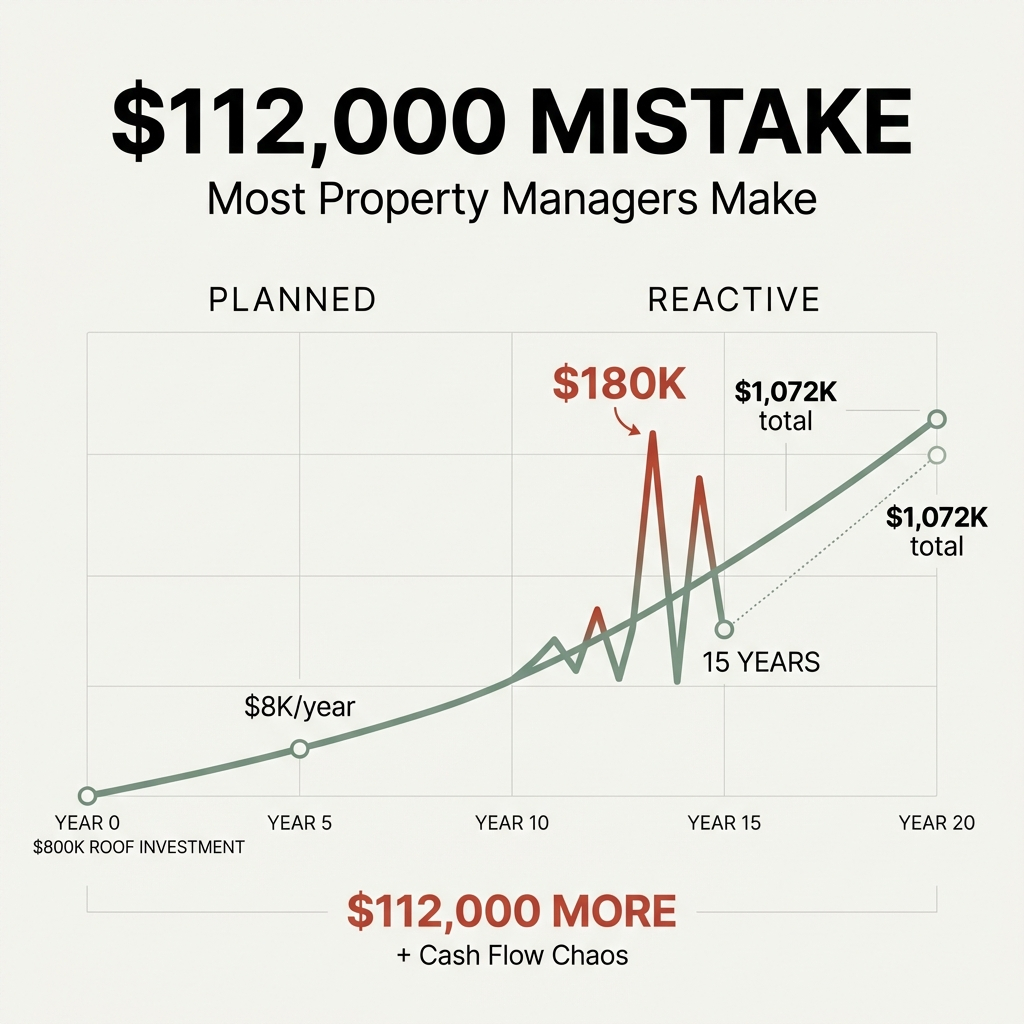
Year 13: Emergency repair event = $180,000 (including hidden costs)
Year 14: Major repair = $75,000
Year 15: Emergency replacement = $800,000
Year 16-20: New roof, minimal costs = $5,000
Total 20-year cost: $1,072,000
Annual average: $53,600
The reactive approach costs $112,000 more over 20 years. But the real damage shows up in the cash flow volatility.
Planned maintenance gives you predictable $8,000 annual expenses. Reactive repairs hit you with $180,000 in year 13, $75,000 in year 14, and $800,000 in year 15.
That volatility destroys capital planning. It forces you to scramble for emergency funding. It disrupts your other investment priorities.
The Lifespan Impact Nobody Talks About
The National Roofing Contractors Association found that regular maintenance can extend a commercial roof’s lifespan by up to 50%.
A 15-year study by Firestone and ProLogis showed proactively maintained roofing systems lasting an average of 21 years compared to just 13 years with reactive maintenance.
That 8-year difference transforms your capital planning entirely.
Not having a preventive maintenance program can reduce the expected life of a roof by 25% or more. When neglected roofs fail, repair costs can reach 3% or higher of the original roof cost annually during the final years.
I tracked properties where 80% of commercial roofs were replaced prematurely due to inadequate maintenance. That represents massive wasted capital across the industry.
Think about what an extra 8 years means for your property. That’s 8 more years of rental income without a major capital expenditure. That’s 8 more years of stable cash flow. That’s 8 more years before you need to secure replacement financing.
What I Would Do Differently
If I were managing a commercial property today, here’s how I would structure the roof maintenance budget:
Allocate 1% of original roof cost annually for maintenance. This creates a predictable expense line that prevents catastrophic failures.
Schedule biannual inspections. Spring and fall inspections catch minor issues before they become major problems.
Maintain a detailed maintenance log. Documentation proves maintenance history for insurance claims, property sales, and warranty enforcement.
Build a roof reserve fund. Even with excellent maintenance, eventual replacement is inevitable. Funding it gradually beats scrambling for emergency capital.
Track total cost of ownership. Your roof maintenance budget should include not just repairs but also the hidden costs of failures: business interruption, tenant relations, insurance impacts, and depreciation effects.
The International Facility Management Association reports that preventive maintenance programs can deliver a 545% ROI. Property managers save up to 30% on repair costs and extend asset lifespans by 20%.
Those numbers match what I’ve seen in real properties.
The Bottom Line
A $15,000 annual maintenance budget prevents $80,000+ emergency repairs.
But the real value shows up in what you avoid: tenant disruption, business interruption claims, accelerated depreciation, insurance premium increases, and the capital planning chaos that emergency replacements create.
I’ve seen property managers try to save money by skipping maintenance. It never works.
The roof always fails. The only question is whether you control the timing and cost, or whether the failure controls you.
Planned maintenance gives you control. Emergency repairs take it away.
The choice seems obvious when you see the actual numbers.